
Ultimate Guide to Utility Transfers for Movers
Moving homes in New Zealand? Sorting utilities early can save you stress, time, and money. Here's what you need to know:
-
Plan 2–4 weeks ahead: Notify your electricity, gas, and broadband providers early to ensure smooth transitions.
-
Take meter readings: Photograph final and initial readings to avoid billing disputes.
-
Align with tenancy rules: Tenants must give at least 28 days' notice when ending a lease.
-
Internet setup: Fibre installations may need weeks and landlord approval if you're renting.
-
Bundle services: Some providers offer perks like free TVs for bundling broadband and energy.
-
Mail redirection: NZ Post charges $60–$165 depending on the duration.
Avoid common mistakes like procrastinating, assuming current providers will work well at your new address, and forgetting to update your forwarding address. Services like Movinghub can help simplify the process by managing utility transfers in one call.
Start early, stay organised, and enjoy a smoother move!
Moving Timeline: When to Transfer Your Utilities
4-6 Weeks Before Moving
Begin by booking removalists and researching utility providers in your new area. Arrange for NZ Post mail redirection - this costs $60 for two months, $99 for four months, or $165 for a year [9][10][5]. Update your details with key organisations such as the IRD, NZTA (for your driver licence and vehicle registration), and the electoral roll [9][6]. Once these are sorted, you’ll be ready to notify your current utility providers in the coming weeks.
2-3 Weeks Before Moving
Contact your current utility providers to provide your exact move-out date and new address. Schedule disconnection for the day after you move to ensure utilities are available for final cleaning [11]. As Powershop advises:
"In most cases it's possible to give companies plenty of notice around a move, so you can do this early and not have to worry about it at move time" [12].
Organise connection dates at your new property, ideally for the day before you arrive. Keep in mind that internet and fibre installations often require a technician visit, which can take several days or even weeks [11]. Reach out to your local council to arrange water service and rubbish bin transfers at least two weeks prior [6][11]. If you're bundling services, providers like Nova Energy may offer perks - such as a free 43-inch LG Smart TV when you switch both broadband and energy [6]. Use this time to confirm all arrangements and prepare for the final week.
1 Week Before Moving
Double-check all connection and disconnection dates with your providers. Begin clearing out perishables from your fridge and freezer [13]. Pack a "first-night kit" with essentials like a kettle, tea or coffee, chargers, basic tools, toilet paper, and bed sheets. It's also a good idea to schedule an online grocery delivery for the evening of moving day [9][13]. Before leaving your current property, take photos of clean, empty rooms to safeguard your bond refund [13].
Moving Day Tasks
On moving day, complete final checks to ensure a smooth utility transfer. Defrost your fridge and freezer 24–48 hours in advance, wipe them dry, and leave the doors open to prevent mould [9][14]. Secure your washing machine with transit bolts and drain all hoses before transport [9]. Before handing over the keys, confirm that the hot-water cylinder is switched off (if necessary), all appliances are unplugged, and windows are locked [9][14].
At your new home, confirm that electricity, gas, and water are active as scheduled. Reconnection fees typically range from $70 to $120 [9]. Test taps, switches, and internet connections immediately - it's much easier to report any issues on day one than to discover them later.
How to Transfer Utilities in New Zealand
When you're moving, sorting out your utilities on time is one of the most important tasks on your to-do list. Here's how to handle electricity, gas, broadband, and council services efficiently.
Electricity and Gas
Once your moving date is locked in, let your current electricity and gas providers know about the change [12]. This is also a great opportunity to explore better deals - tools like Power Compare can help you find competitive rates or special sign-up offers [6]. On moving day, make sure to take final meter readings for both gas and electricity, and snap a photo for your records. This helps ensure you're billed accurately [6][12]. Before leaving, turn off the electricity switchboard and gas meter at your old property [6].
At your new home, take initial meter readings as soon as you arrive. This will serve as the starting point for your new account [6]. If you run into issues that your provider can't resolve, you can contact Utilities Disputes, a free service that handles power and gas complaints in New Zealand [15]. For added convenience, consider providers that offer "dual fuel" (gas and electricity) or even "triple play" packages, which bundle power, gas, and broadband into one bill - these options can simplify things and may save you money [6].
Broadband, Phone, and Fibre
Fibre broadband is the gold standard for internet in New Zealand, offering the fastest and most reliable connection. However, it's mainly available in urban areas [2]. To avoid delays, check fibre availability at your new address early using tools like the Chorus copper withdrawal tool or your provider's website [2].
When moving, pack up your modem and cables carefully to ensure they're ready to go at your new place [1][2]. If you're renting and the property requires a fibre installation, you'll need written permission from your landlord before any work begins [2]. The good news? Fibre installation is typically free, thanks to a government-backed initiative [2].
If a technician is required, schedule the appointment after you've taken possession of the property [2]. Keep in mind that New Zealand is phasing out its old copper network, so if your new home still relies on older technology, you'll need to upgrade to fibre or consider wireless options [2].
Water, Rubbish, and Council Services
Handling water and council services is straightforward but essential. In New Zealand, property owners are responsible for water and wastewater charges, unlike electricity, which is usually in the tenant's name [16]. On your move-out day, take a final water meter reading and photograph it for accuracy [16][12]. If you're renting, check with your landlord or property manager about how water readings will be handled to ensure you're only paying for what you've used [16]. For Auckland residents, you can request an out-of-cycle invoice based on a self-reading for $27.50 [16].
Make sure to notify your local city or district council about your move. This updates the electoral roll and ensures rates invoices are sent to the correct address [6]. For rubbish services, you'll need to manage the wheelie bins for general waste, recycling, and green waste. Collection schedules vary by area, so confirm the pickup days with your new local council [12]. Before leaving, it's helpful to leave any operation manuals for council-provided bins or water systems for the next occupants [6].
Simplify Your Move with Movinghub
Connect utilities, change your address, and compare home services all in one place. Join thousands of users and property professionals using our platform to save time and money.

How Movinghub Simplifies Utility Transfers
Sorting out utility providers and scheduling connections can easily become one of the most stressful parts of moving. Movinghub takes that hassle off your plate, acting as a one-stop service for all your utility needs. Here’s a closer look at how Movinghub makes transferring utilities a breeze.
What Movinghub Offers Movers
Say goodbye to endless phone calls and long hold times. With Movinghub, you can arrange connections for electricity, gas, LPG bottles, phone/broadband, and Sky TV - all in a single call. Whether you want to transfer your current utility accounts to your new address or explore better options with new providers, Movinghub has you covered. Once you’ve selected your services, a dedicated Mov-ol-o-gist will reach out to discuss personalised plans and take care of the setup for you.
But that’s not all. Movinghub can also organise quotes for movers, professional cleaners, and storage facilities, adding even more convenience to your moving journey. Need help? Call Movinghub on 0800 668 369 for quick and reliable assistance. [8]
Movinghub’s efficiency isn’t just for individuals - it also caters to industry professionals.
Services for Property Professionals
Beyond helping movers, Movinghub collaborates with property professionals like lawyers, real estate agents, and property managers to make their clients’ moving experiences smoother. Turner Hopkins describes the partnership perfectly:
"Let's face it, moving home can be a nightmare which is why we've partnered with Movinghub to offer you a fast, free and convenient service to arrange the connection of all your utility services at your new property, in just one phone call."
Common Utility Transfer Mistakes to Avoid
Even the most organised movers can trip up when it comes to utilities. One of the biggest culprits? Procrastination. Waiting until the last minute to sort out utility connections can leave you scrambling when you should be settling into your new home. Ideally, you should start researching and handling the paperwork 1–2 months before your move-in date [17]. Al Hall from Trade Me Property offers some straightforward advice:
"It pays, quite literally, to do some thorough research on who provides the best service at your new address" [17].
Another common misstep is assuming your current provider will deliver the same quality service at your new location. Service levels can vary widely depending on where you’re moving, and you might find yourself dealing with outages or slower internet speeds than you’re used to [17]. Don’t overlook smaller services like wheelie bins, newspaper delivery, or milk runs, as these can also cause unexpected disruptions [12]. Setting up mail redirection early is another must to avoid missing important communications.
Providing incomplete information is another mistake that can delay your transition. Make sure you have your Meter Point Administration Number (for electricity) or Meter Point Reference Number (for gas) ready when contacting providers - missing these can lead to frustrating delays [17]. A helpful tip: take date-stamped photos of utility meters at both your old and new residences. This ensures you won’t be billed for someone else’s usage [6][11][12], and for renters, it can prevent disputes over bond deductions.
To make your move smoother, follow the 48-hour rule: ask your electricity provider to keep the power on at your old place for 48 hours after you move out [4]. This gives you extra time for final cleaning or retrieving forgotten items. Similarly, ensure utilities are up and running at your new home at least a day before you arrive - no one wants to unpack in a dark, cold house [4][11].
Avoiding these pitfalls can help streamline your utility transfer and reduce stress on moving day.
Electricity, Gas, Broadband, and Water: Transfer Times and Fees
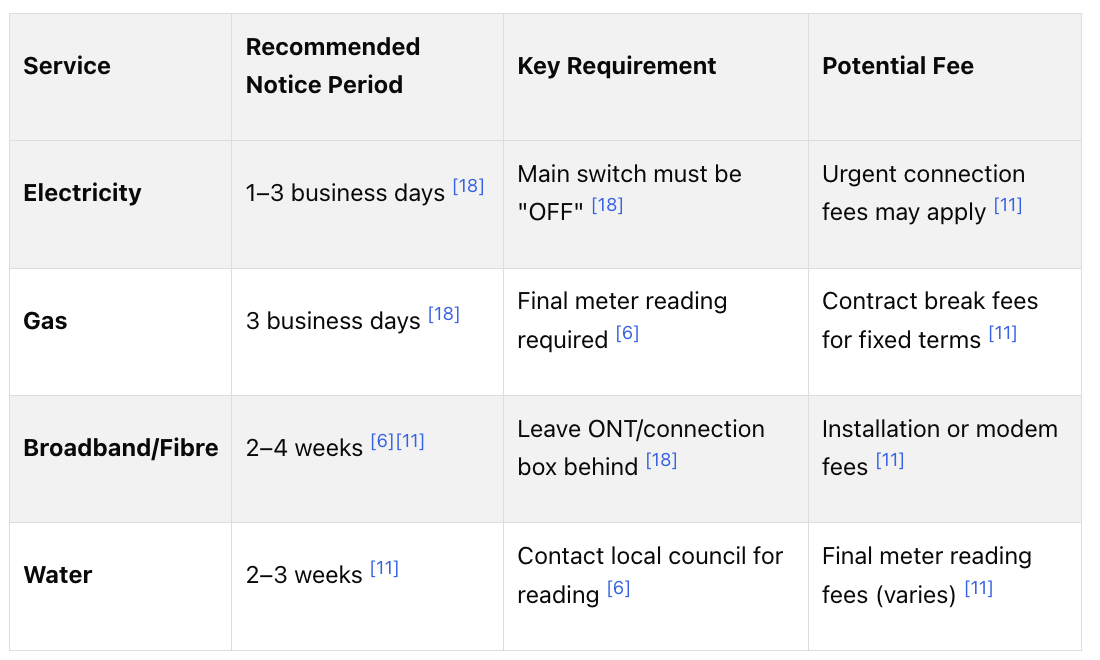
Make sure to provide your utility companies with a forwarding address to receive final bills and avoid late payments, which can harm your credit rating [7]. If you’re moving to a rural area, contact NZ Post at least a month ahead to organise delivery services [5]. These small but important steps can save you from unnecessary stress during your move.
Conclusion
Sorting out utilities doesn’t have to be the most stressful part of your move. The secret? Planning ahead. Reach out to your utility providers at least two to three weeks before your moving date to ensure everything is in place [3]. This way, you’ll arrive at your new home with essential services ready to go, avoiding any last-minute chaos.
"A hassle-free move is largely a matter of remembering the details, and dealing with utilities well in advance of moving day can help ensure anyone's peace of mind." – Moving.com [3]
Don’t forget to confirm final meter readings, update your forwarding address, and keep utilities active for an additional 48 hours after your move [3]. These small but important steps can save you from financial headaches and help avoid billing disputes.
If juggling multiple utility accounts feels overwhelming, there’s a simpler way. Services like Movinghub can take the hassle out of the process. With just one phone call, you can arrange electricity, gas, broadband, and more. Plus, if you’re a client of partner firms like Turner Hopkins, this service is completely free [8].